
Indian Space agency Indian Space Research Organisation would launch the Geo-synchronous Satellite Launch Vehicle-Mark III (LVM3 X mission) on December 18 which would carry active solid boosters, liquid core stage and a passive cryo-stage.
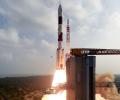
The Indian Space Research Organisation (ISRO) is all set to make its maiden commercial launch of 36 broadband communication satellites on board the space agency's heaviest rocket LVM3-M2, the countdown for which began early on Saturday at Sriharikota spaceport in Andhra Pradesh.

Russia's state space corporation, Roskosmos, according to the Reuters report, said it had lost contact with the spacecraft shortly after a problem occurred as it was shunted into pre-landing orbit on Saturday.

Confusing academic freedom with the right to free speech of an individual and expecting unconditional institutional support is not realistic. Academic freedom provides an opportunity for an academic to pursue their passion and contribute to the society through the outcome of their research and/or thought process, points out N Ravichandran.

This would be the 44th flight of the PSLV and the third launch by ISRO this year.

While Team Indus had backing from Nandan Nilekani, Ratan Tata and Flipkart founders Sachin and Binny Bansal, it could not even muster half of the Rs 4.5 billion it required for the mission to the moon.

The Indian Space Research Organisation (ISRO) successfully launched its third and final developmental flight of Small Satellite Launch Vehicle here on Friday whose payloads can be used in applications like satellite-based surveillance, disaster and environmental monitoring, fire detection, volcanic activity among others.

The test vehicle development flight (TV-D1) is aimed at testing the crew module that will carry Indian astronauts during the human spaceflight late next year.

The ISRO said that 90 to 95 per cent of the mission objectives have been accomplished, notwithstanding the loss of communication with the lander.

The Indian Space Research Organisation (ISRO) on Thursday announced that its lunar mission Chandrayaan-3 will be launched on July 14 from the space port at Sriharikota in Andhra Pradesh.

The launch of Polar Satellite Launch Vehicle (PSLV-C52) is scheduled at 05:59 hours on Monday from the First Launch Pad of Satish Dhawan Space Centre, Sriharikota, the Bengaluru-headquartered space agency said.

Weighing about 5,854 kg, GSAT-11 would play a vital role in providing broadband services across the country, and also provide a platform to demonstrate new generation applications.

Sixty high school students who cleared an online space quiz last month were at the centre to witness the India's endeavour.
While industry is upbeat, start-ups in the space sector are finding it difficult to cater to the demand due to a lack of funding, issues related to policy like foreign funding, intellectual property, etc, and a lack of support in testing.

Chandrayaan-3's success is a must for India's space ambitions; we can't afford to lose out. And for realising our space dreams, the Indian private sector must be encouraged because if we lose this race, the moon, Mars, and mineral-rich asteroids will already be crowded before we reach there.

The rover will carry out in-situ chemical analysis of the lunar surface during the course of its mobility.

Chandrayaan-2 will explore a region of the moon where no mission has ever set foot. The spacecraft consists of an orbiter, a lander, and a rover together referred to as "composite body".

India's advanced multi-band communication satellite GSAT-7, launched from French Guiana by European space consortium Arianespace's Ariane 5 rocket on August 30, has been successfully placed in the geosynchronous orbit with an altitude of about 36,000 km above earth's surface.

The hollow metal spheres, each of about 1.5 feet diameter, fell between May 12 and 13 in Dagjipura, Khambholaj and Rampura villages of Anand district and Bhumel village of neighbouring Kheda district

'Techfest', an annual science and technology event organised by the Indian Institute of Technology Bombay in Mumbai.

The COVID-19 lockdown has hit several projects of the ISRO including Chandrayaan-3, which was scheduled to be launched in late 2020, and Gaganyaan, the country's first manned space mission.
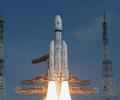
He said the test vehicle is ready at Sriharikota and the assembly work of the crew module and crew escape system has also begun.

Dravida Munnetra Kazhagam (DMK) leader and Fisheries Minister Anitha Radhakrishnan accepted the mistake on Thursday after the Tamil Nadu government was left red-faced after an advertisement for a new Indian Space Research Organisation (ISRO) that featured a rocket with the flag of China.
"I am extremely happy to announce that GSLV Mark III successfully injected Chandrayaan 2 in the defined orbit, infact the orbit is 6,000 km more than what was intended," Sivan said.

Vyomamitra, a combination of two Sanskrit words Vyoma (Space) and Mitra (Friend), took everyone by surprise when she introduced herself to the audience gathered there.

"The panel's report is awaited. The committee has been given a guideline to prepare the mission before the end of next year," a senior ISRO official said. "There is a good launch window in November".

'I am extremely excited to be at the ISRO Centre in Bengaluru to witness the extraordinary moment in the history of India's space programme,' Modi tweeted earlier in the day.

Here is a glimpse of the journey of India's third lunar exploration venture has taken so far.

The new year will witness two unmanned missions under the "Gaganyaan" project, deep ocean exploration project, "Samudrayaan" and many more.

The earth observation satellite would provide real-time images of the country and also be able to quickly monitor natural disasters.

The year ended with the launch of the PSLV's 50th mission.

According to news reports, ground images for this operation were provided by the recently launched Cartosat 2C satellite.

'Today onwards, the onboard thrusters will be fired and Chandryaan-3 will be taken away from Earth for an eventful landing on Moon's surface on August 23'

Being driven to abandon Indian middle-class values, asks Ajit Balakrishnan.

Dr Bhabha and Dr Sarabhai didn't feel guilty for their ambitions; it was for those 'mad scientists' that India is a powerhouse -- both at the atomic level and in the vastness of space, observes Kumar Abishek.
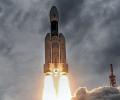
Chandrayaan-II hard-landed on lunar surface last year. The Indian Space Research Organisation had then resolved to launch the project again. It had said the project is likely to be launched by the end of the year.

The Supreme Court on Wednesday rapped the Haryana and Punjab governments over non-prosecution of violators found guilty of stubble burning and summoned the state chief secretaries to appear before it on October 23 and submit. an explanation.

The Indian Space Research Organisation (ISRO) is set to welcome the new year with the launch of its first X-Ray Polarimeter Satellite that would offer insights into celestial objects like black holes, onboard a Polar Satellite Launch Vehicle rocket on Monday.

Vikram (with rover 'Pragyan' housed inside) is expected to touch down on the lunar surface on September 7, between 1.30 am and 2.30 am.
